Everything you think. In one long conversation.
Singularity Codex is a private message history with yourself. Send a thought, a task, a link, a photo — it lands permanently, at the moment you sent it.
A demonstration — nothing you type leaves this page. There is no username to claim, no account, and no server to hold one.
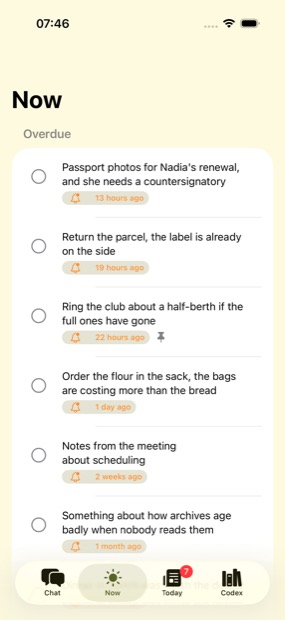
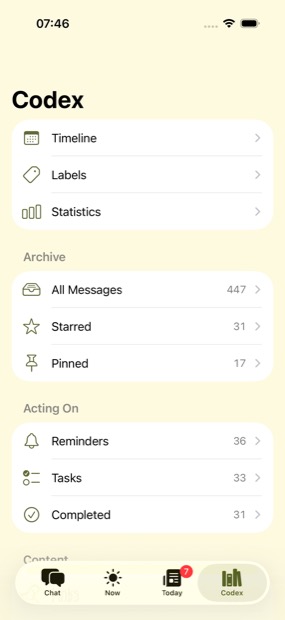
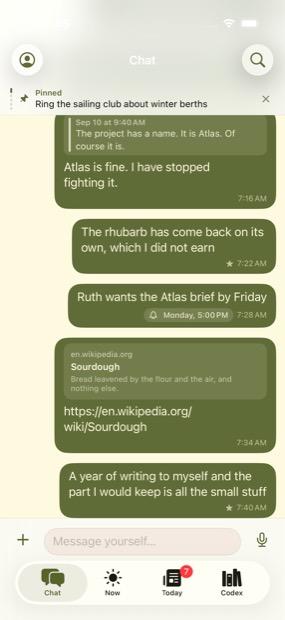
Capture first. Organise later.
You never choose a notebook, a folder, a project or a tag before sending something. Time is the organising structure; everything else is derived from it. One attachment is one message, so a photo can be starred, replied to and found on its own.
See it label a sentence →
The things that will not wait.
Reminders due, tasks still open, anything pinned, and the same date in earlier years. Three hundred neglected reminders are not “things worth responding to today”, so each section shows a handful and points at the rest.
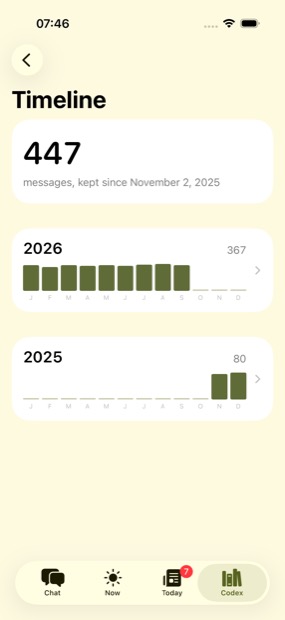
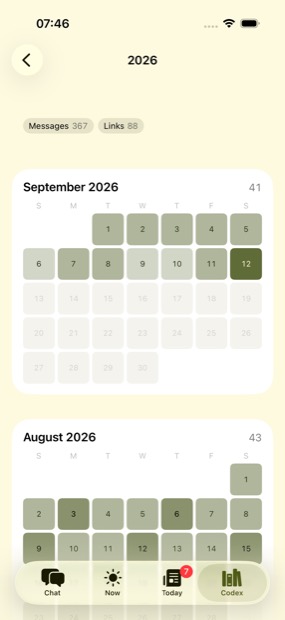
A year is a shape.
Twelve calendars say that this year started slowly and ran full through spring. Squares are shaded against that month’s own busiest day, so someone who writes three things a day and someone who writes three hundred each see their own rhythm.
Nobody decides what you read. Not even us.
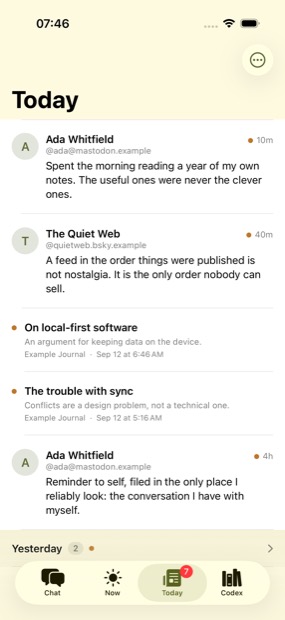
Follow a site’s feed, a podcast, a YouTube channel, a Mastodon account or hashtag, a Bluesky account or feed, a subreddit. They arrive in one timeline, newest first, cut into days — no ranking, no recommendation, nothing promoted, because there is no service of ours between you and them. Your phone asks each source directly, with no account anywhere.
It reads, and that is all it does: nothing to like, repost or reply to. Mute a word or hide someone and their posts stop arriving; keep a post and it becomes a message in your archive. What other people published is cached outside your archive, and never synced to your iCloud.
It reads the sentence, not just the words.
Labelling runs on the phone’s own language models — never uploaded, never shown to anyone, and it never changes what you wrote. The same reading runs in this page. Type anything, in any of the languages below.
It comes back when you said.
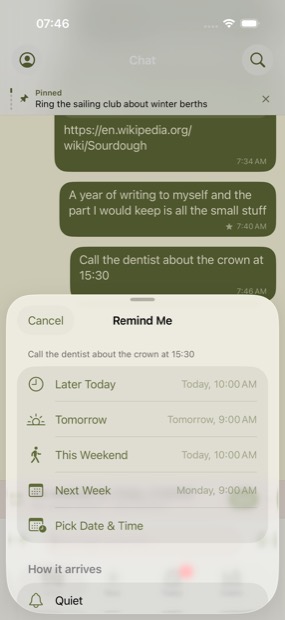
Write “call the dentist at 15:30” and Codex offers a reminder for half past three — “in ten minutes” and “next week” too, in any of five languages. It arrives as a notification: quiet by default, time sensitive when you named a moment close at hand, so it gets through a Focus.
Reminders, not alarms: anything you cannot afford to sleep through belongs in the Clock app. Turn off “Show message in notification” and the Lock Screen only says there is something to look at.
Your Codex stays yours.
Not a policy — a shape. There is no server of ours to send anything to.
Nothing to sign up for, nothing to sign in to, no identity to lose.
Messages live on the device, and — only if you switch it on — in your own private iCloud.
Worked out on device, never shown to anyone, and they never alter what you wrote.
Transcription is on-device or not at all. A recording is never uploaded to be read.
A link you saved, a page you open, iCloud if you turn it on. Your words are never part of the request.
A zip of JSON, the same messages as plain text, and every file — so it outlives the app.
Everything has a place in time.
Start where you are. The first message is the archive.
Still a demonstration. Still no username, and no account.